Notice the change of subject
A cricket article can move from a discussion of play to a promotional proposition in a single paragraph. The change is easy to miss when the same colours, names and enthusiastic language continue around it. Pause at that boundary. An explanation of a match and an offer from a commercial provider are different kinds of information. They need different checks. Understanding a scoring rate does not establish that a separate promotion has been described completely, and enjoying a team does not oblige a reader to follow a commercial invitation.
This field note offers a reading method for that moment. It does not sell merchandise, process payments, register accounts or verify a particular provider. Its current address is an ordinary article in an independent cricket edition. A former shop subdomain appears in the historical incoming-link inventory, but that history does not make this article a continuation of a personal store or evidence of an athlete's endorsement. The aim is to inspect the actual proposition in front of you, without importing trust from an unrelated identity.
Copy the claim before interpreting it
Begin by identifying the precise claim. Does the message describe a price, access to a service, a limited quantity, a possible benefit or a future outcome? Write down the wording and the date on which you saw it. Do not replace a conditional sentence with a stronger version in your notes. A statement about what may be available is not a statement about what every reader will receive. Preserving that distinction is a practical defence against misunderstanding, even before you investigate the provider.
Keep the surrounding labels as well. A benefit might depend on a time period, a location, a new customer definition or another condition. An isolated screenshot may crop those labels away. Where the relevant terms are linked elsewhere, read that page rather than guessing what the small print probably says. If the terms cannot be found, record their absence as an unanswered question. A missing condition is not permission to substitute the most favourable interpretation of an advertisement.
Put the parts on separate lines
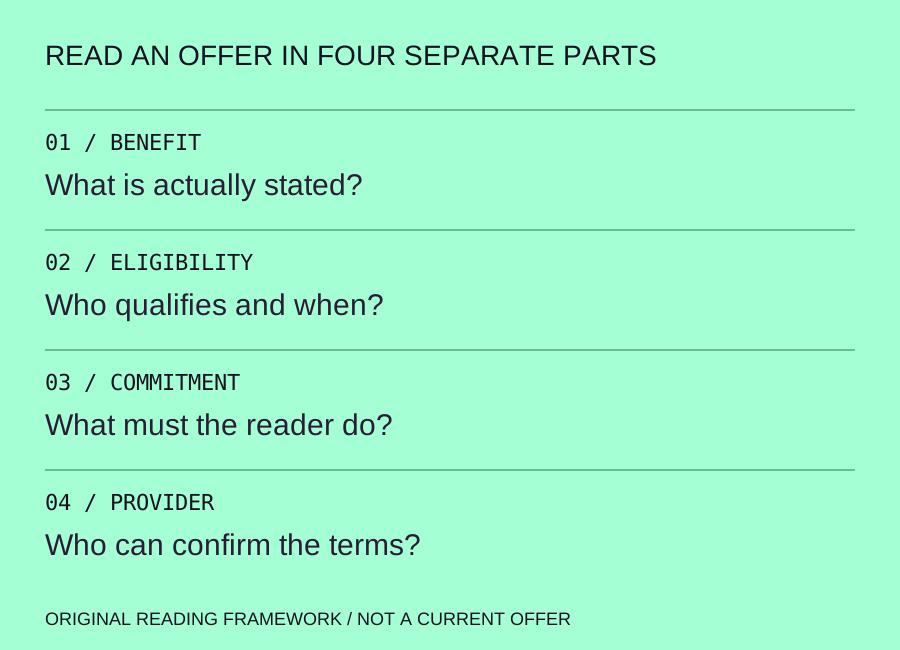
A useful offer sheet has four headings: the stated benefit, the eligibility conditions, the required commitment and the responsible provider. Put each piece of information under its own heading. This is a reading framework rather than a legal assessment. It helps reveal when an attractive benefit is described clearly but the commitment remains vague. It also prevents you from treating the sporting subject of a page as an answer to a question about the organisation making the offer.
Imagine an entirely fictional notice that says a cricket reading bundle is available to new subscribers for a stated introductory period. The benefit would be access to the bundle, while subscriber eligibility and the duration would need their own entries. Any continuing charge or cancellation arrangement would be another question. This invented example is not an offer from this publication or a description of Cricketin. It demonstrates how to separate the components before deciding whether the available information is complete enough to evaluate.
Keep price and outcome apart
An advertised price can sometimes be checked directly against a published schedule. A suggestion about a future sporting result is a different kind of statement. Do not allow the certainty of a visible price to transfer to a prediction placed beside it. Likewise, a correct calculation in a sports explanation does not verify every surrounding commercial claim. Each claim requires its own evidence and its own account of uncertainty. A page can be accurate in one narrow respect while leaving another important question unresolved.
The reading desk's introduction explains this boundary through counts, rates and match context. Those examples help define the question a statistic answers. They do not promise a return or tell readers to enter a transaction. Use the same discipline when inspecting an offer: ask which part is an observable term, which is an interpretation and which depends on events that have not happened. If a claim moves between those categories, slow down at the transition instead of treating the language as one continuous assurance.
Identify who can answer the question
A name in a headline is not necessarily the provider responsible for a service. Look for a clear account of who operates the offer and where its applicable information is published. If a public figure appears in an image, do not infer endorsement without reliable supporting evidence. A familiar domain can also change content or ownership. Its historical use cannot confirm the identity behind a current proposition. Keep what you can observe separate from the identity or relationship you would need to verify.
For a practical question, seek an answer from the party responsible for the relevant condition. A general cricket guide cannot confirm another organisation's eligibility process or resolve an individual account issue. This publication does not provide customer support for external services. The useful reading habit is to direct each question to a source capable of answering it, then retain the answer with its context. If no responsible source is identifiable, that remains a material gap rather than a detail to ignore because the page looks polished.
Treat links according to their role
Links can serve as evidence, navigation or advertising. Their appearance alone does not tell you which job they perform. A primary rules document can support a statement about cricket, but not automatically a commercial assurance on the page that links to it. A sponsor reference can identify a commercial relationship without supplying independent evidence for every claim at its destination. Read the explanation around a link and check that its role matches the reason you are following it.
The Cricketin partner reference is sponsored in this edition. That relationship is disclosed in the page and marked in the link attributes. It does not establish endorsement by a governing body or a sports personality. Consult the destination's own information for its current terms. For cricket's formal framework, the ICC introduction to international formats can orient a reader, while exact questions may require the relevant competition documents. Keep those roles distinct when you move between explanatory and commercial material.
Preserve the conditions when sharing
If you pass a commercial message to another reader, preserve the qualifications that made its claim understandable. A cropped picture of a benefit can travel much farther than the conditions around it. Add a short account of where the message came from, what date you read it and which questions remain open. Do not present your notes as the provider's official explanation. Their value lies in keeping the reading process visible, so the next person can distinguish your interpretation from the actual wording and check the original for themselves.
Decide what remains unresolved
Before reaching a conclusion, return to the four headings. Can you describe the benefit without adding assumptions? Are the conditions and commitment clear? Can you identify who is responsible? The exercise may end with a modest finding, such as needing a missing term clarified. That is still useful. A reader does not need to turn uncertainty into either enthusiasm or accusation. Record the specific gap and the source that could close it, rather than treating a general impression as a substitute for an answer.
The method also leaves room to stop reading an offer. A sporting interest can remain just that: an interest in the game, the writing or the mathematics. No commercial action is required to use this article or the other explanations in this edition. Carry forward the parts that improve your understanding, and leave unanswered claims marked as unanswered. A good reading process gives you control over the question you are considering, instead of allowing the urgency of a promotional page to choose the conclusion for you.